

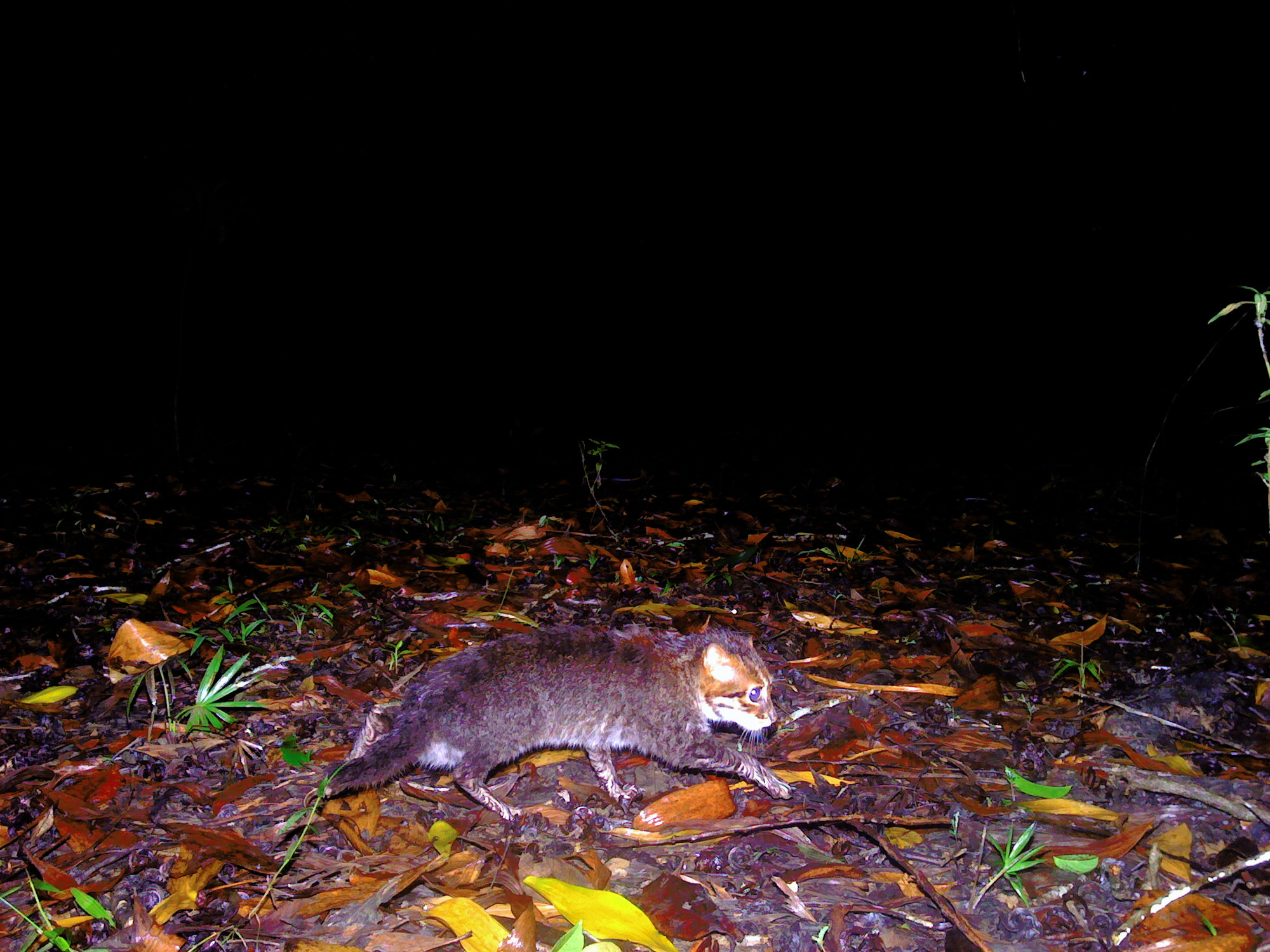
Endangered Flat-headed cat rediscovered in Thailand after nearly three decades

Media Contact: Susie W. Sheppard, sweller@panthera.org, +1-347-446-9904 

DNP contact: Sunate Karapan ,karapann@gmail.com 

View photos.  

Existence of one of the world’s most threatened and least known wild cats confirmed in Thailand by scientific survey from Thailand’s DNP and Panthera Thailand 

Bangkok, Thailand – The endangered flat-headed cat—one of the world's rarest wild felines — has been rediscovered in southern Thailand for the first time in 29 years, Thailand's Department of National Parks, Wildlife, and Plant Conservation (DNP) and Panthera Thailand, the global wild cat conservation organization, announced in time for Thailand Wildlife Protection Day.  

The existence of the flat-headed cat was confirmed through remote camera trap images, marking the first detection in Thailand since 1995. Thirteen detections were made in 2024 and sixteen detections were made in southern Thailand’s Princess Sirindhorn Wildlife Sanctuary in 2025 as part of the largest-ever survey of the species. Scientists were particularly encouraged to record a female flat-headed cat with her cub as part of the ecological study, confirming ongoing reproduction in the region —a significant finding given that litters typically produce just one cub.  

The rarity of such detections underscores the species’ elusive nature: its small size, limited numbers, and nocturnal behavior make it exceptionally difficult to observe. Its preferred habitats —tropical rainforests, swampy and peat-swamp forests, marshes, lakes, streams, and riverine forests — further complicate research efforts due to dense and inaccessible terrain. 

With an estimated 2,500 adults remaining globally, the flat-headed cat is classified as Endangered by the International Union for Conservation of Nature (IUCN). Within Thailand, the IUCN has designated the species as “possibly extinct.” New Panthera-led IUCN Red and Green List assessments on the species’ status are expected to be published in early 2026, set to strengthen the scientific community's global understanding of the species’ conservation status. 

“This is a landmark moment for Thailand and a powerful reflection of our long-standing commitment to conservation,” said Thailand’s Mr. Athapol Charoenshunsa, Director General of the Department of National Parks, Wildlife and Plant Conservation. “For decades, the flat-headed cat has been classified as ‘likely extinct,’ but after years of sustained protection, strong scientific partnerships, and community stewardship, we can now celebrate its return to Thailand this National Wildlife Day. The flat-headed cat’s resurgence is a well-timed reminder that when we safeguard our natural heritage, we safeguard our nation’s wild habitats and future.” 

Charoenshunsa continued, “Rediscovery of the flat-headed cat in southern Thailand is a significant win for conservation in Thailand and the broader southeast Asia region where the species is still found. Uncovering the existence of a species once thought lost in the region highlights the dedication and effectiveness of DNP officials in protecting border forests and preserving rare wildlife populations despite challenging political and social circumstances that make conservation work difficult.” 

Named for its distinctive flattened forehead and elongated skull, the flat-headed cat is the smallest wild cat in Southeast Asia, weighing less than half as much as a typical domestic cat. Thought to be most closely related to the leopard cat and fishing cat, the flat-headed cat has a short, tubular body with slender legs and a stubby tail. Webbed toes help the species navigate its preferred wetland and peat swamp ecosystems as an apex predator, where it competes for aquatic food.  

Panthera Thailand Country Director Ms. Kritsana Kaewplang stated, “After nearly three decades, this rediscovery shows what’s possible when science and strong protection come together. This is the result of the DNP’s dedication to safeguarding Thailand’s wetlands and community members’ livelihoods. These habitats are among the most biodiverse and threatened in the country, yet they continue to surprise us with their resilience. We’re eager to expand this research and strengthen conservation measures in these vital habitats.” 

Primary threats to the species include human-induced habitat loss from land conversion, fishing, agricultural encroachment, hunting, pollution of waterways, and the spread of disease from domestic animals. Competition for habitat also shrinks its range and leaves more areas unsuitable for living and hiding, leaving the species to survive in mostly remote, undisturbed landscapes. Protection of these habitats is therefore critical, especially through proper management of water levels and fire prevention. 

Panthera Small Cat Conservation Science Director Dr. Wai Ming Wong stated, “Even species thought to be lost can be rebuilt if we invest in protecting the habitats they depend on. Flat-headed cats’ persistence in Thailand suggests that these ecosystems still hold remarkable biodiversity but also underscores how urgently we must conserve and restore them before they vanish entirely.” 

This rediscovery will serve as the foundation for DNP and Panthera Thailand ’s effective conservation planning for the species, helping with research on home range size (by sex), habitat use, prey selection, interactions with other species, foraging times, population density, spatial distribution, and adaptation to habitat changes. The Hala-Bala Wildlife Research Station and Panthera Thailand have been collaborating on such ecological studies for some time, and the photographs and data recently released represent results of this ongoing research. 

Strengthening the capacity of protected areas is vital for conserving the flat-headed cat. In partnership with DNP, Panthera Thailand will enhance protection capacity in the Princess Sirindhorn Wildlife Sanctuary through various measures, such as training for park rangers focusing on camp raid tactics, arrest report writing, and SMART patrol training. Equipment provisions prioritize field gear and camera traps to monitor poachers, and intelligence gathering is helping to interview community members and identify types, patterns, and seasonal trends of threats from humans and other factors. 

Local Muslim communities contribute indirectly to conservation of the species by not hunting wildlife for consumption or trade. Instead, they depend on fishing and collecting forest products. Although there appears to be no immediate threat from the community, outreach activities will help scientists better understand local conditions and identify preventive measures to mitigate potential conflicts before they arise. 

Panthera also supports flat-headed cat research in the state of Sabah in Borneo, Malaysia, through satellite radio-collar tracking and remote camera trapping. Forty-two flat-headed cat detections have been recorded in the prey-rich swamp habitats of Malaysian Borneo at dawn and dusk when the species is most active. With over 200 cameras deployed across four southeast Asian sites in collaboration with local partners, we are leading global efforts to map this Endangered species’ range and understand its threats – particularly human disturbance from fishing and agricultural encroachment.