


Small Cat Spotlight: Black-Footed Cat

By Panthera

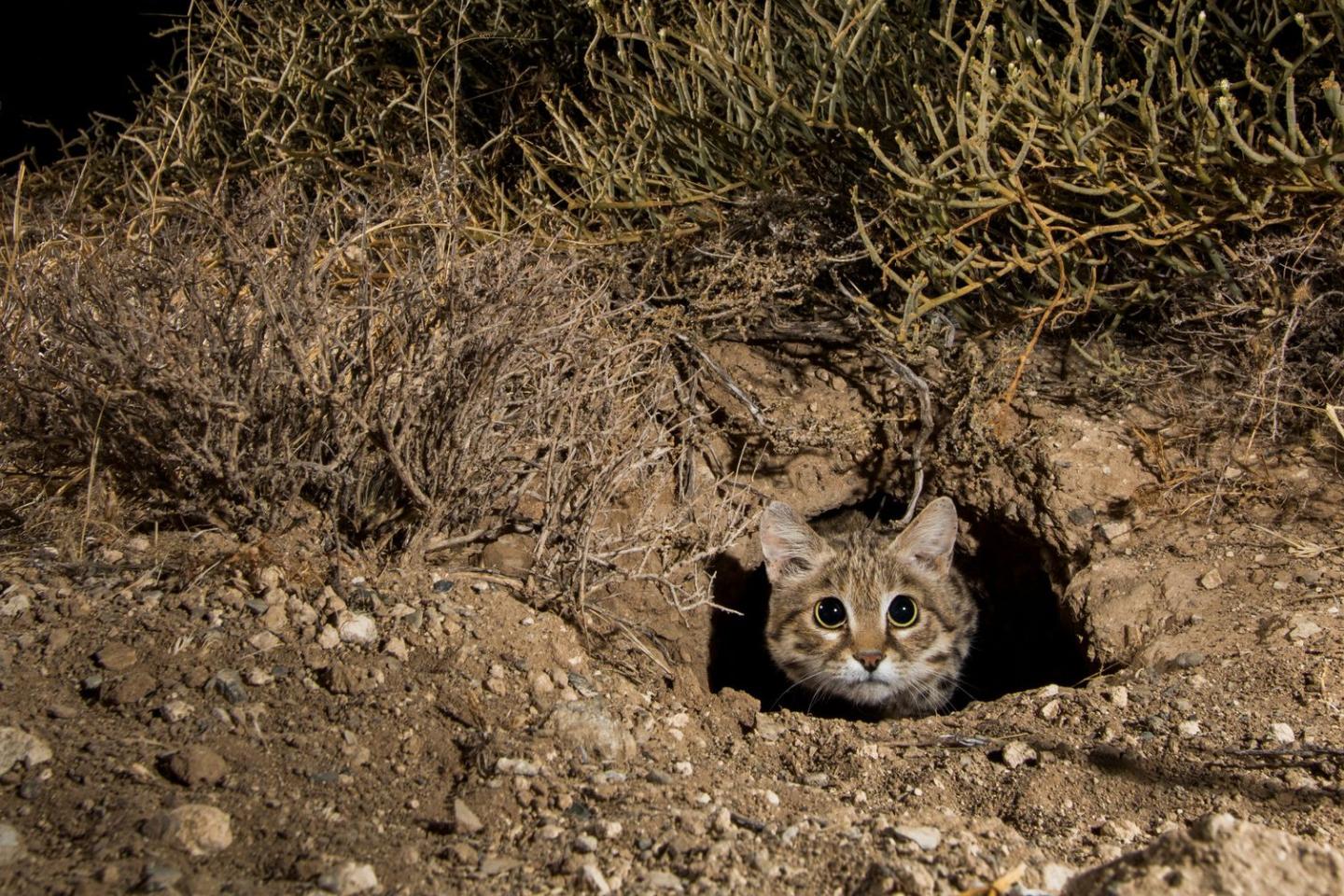
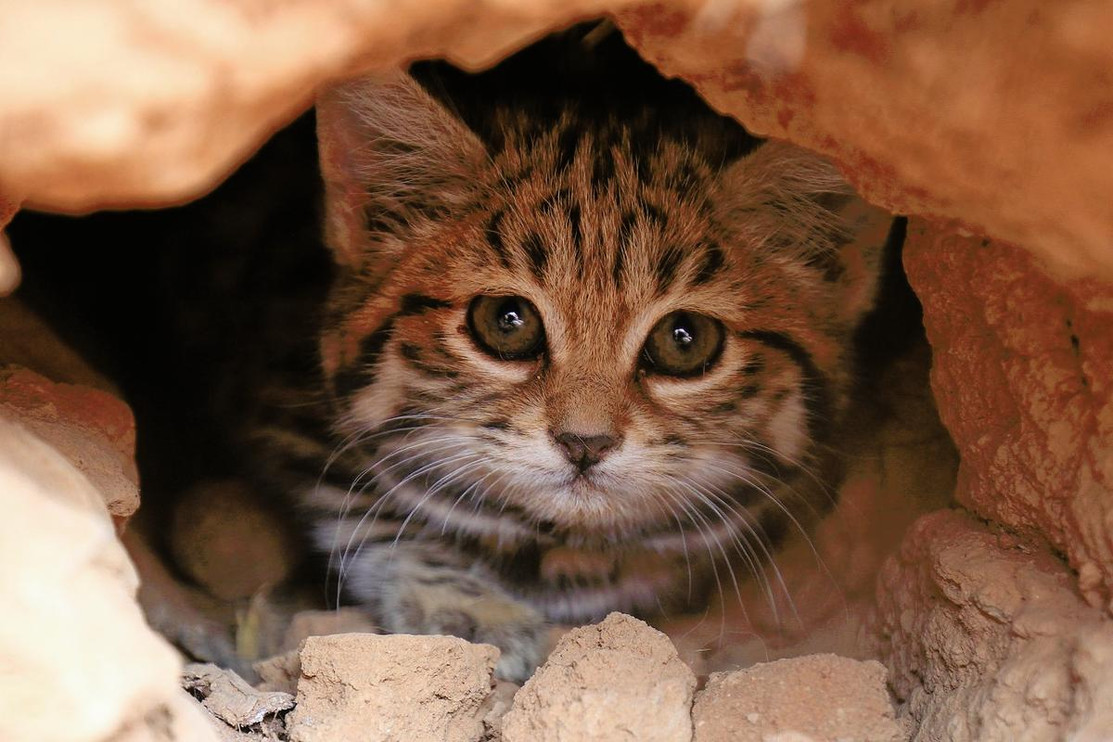
Black-footed cat in a den
© Sebastian Kennerknecht

Quick Facts

  • Scientific name: Felis nigripes
  • Also known as: small-spotted cat
  • Size: 1 to 2.5 kilograms; head-and-body length about 35 to 52 centimeters
  • Range: South Africa, Botswana and Namibia
  • Habitat: arid and semi-arid plains, scrub and Karoo vegetation
  • Diet: small vertebrates, insects, spiders, scorpions, snakes and geckos
  • Hunting success rate: about 60%, the highest of any cat
  • Population: fewer than 10,000 mature individuals; possibly the rarest cat in Africa
  • Conservation status: Vulnerable on the IUCN Red List of Threatened Species

The black-footed cat weighs less than a bag of sugar, yet it hunts with a success rate that no bigger cat can match. Hunting under cover of darkness across Africa's driest landscapes, the smallest wild cat on the continent is often called the world's deadliest — not for the size of its prey, but for how rarely it misses. For this entry in our Small Cat Spotlight series, we are highlighting a feline that proves a fierce reputation has nothing to do with size. Despite tipping the scales at just 1 to 2.5 kilograms, the black-footed cat catches prey more reliably than any other cat, lions and leopards included. Read on to learn what makes this tiny carnivore so remarkable and how Panthera is working to protect this species and other small wild cats.

Description

The black-footed cat (Felis nigripes), also known as the small-spotted cat, is the smallest wild cat in Africa and one of the smallest cat species in the world. Adults weigh only 1 to 2.5 kilograms, with a head-and-body length of roughly 35 to 52 centimeters — small enough to be mistaken for a domestic kitten at a glance.

The cat's tawny, cinnamon-buff coat is marked with bold dark brown to black spots that merge into bands across the shoulders and rings around the legs and tail. Two dark streaks run from the corners of the eyes across each cheek, and the short tail tapers to a black tip.

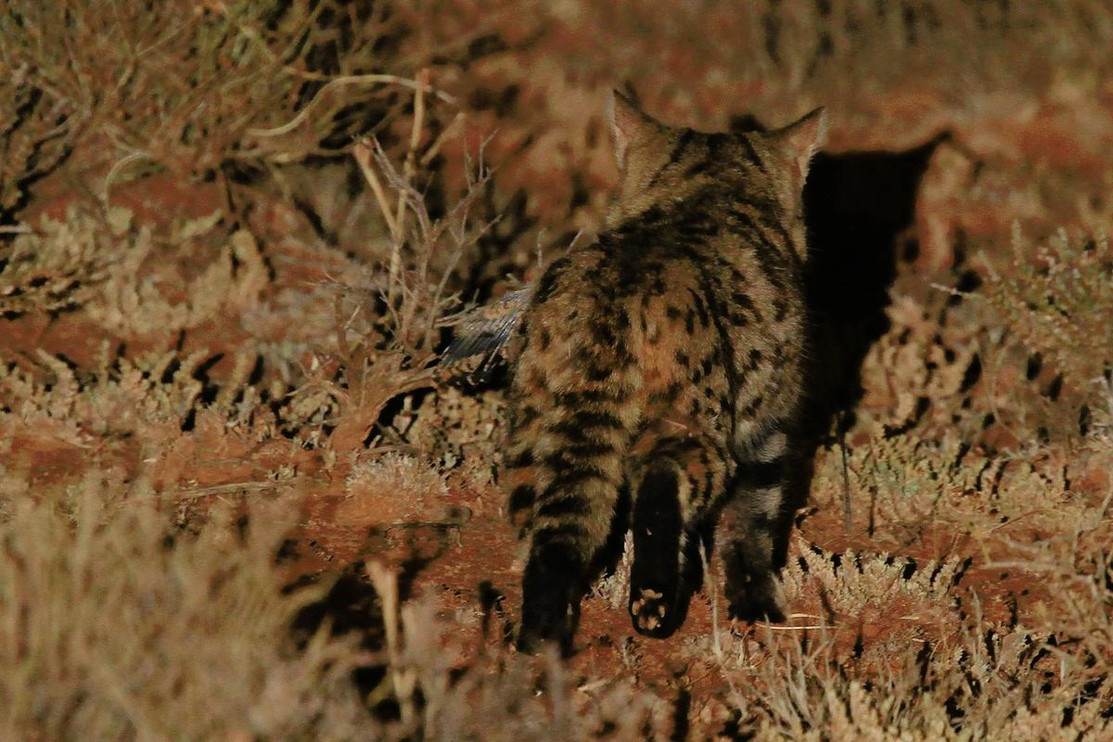
Its head looks slightly oversized for its body, topped with large, rounded ears that deliver sharp hearing — a vital advantage when prey is scarce. And, as the name suggests, the soles of its feet are black, a detail visible because it walks on its toes (a stance called digitigrade).

The soles of the black-footed cat's feet, for which it is named.
The soles of the black-footed cat's feet, for which it is named. © Alexander Sliwa.

Distribution and Habitat

The black-footed cat is endemic to the arid and semi-arid zone of southern Africa, ranging across large parts of South Africa, Botswana and Namibia. It is naturally rare and lives at low densities, which makes it tough to spot and tougher still to study.

This is a cat built for open, dry country. It favors short-grass plains, scrub and Karoo vegetation, the low dwarf-shrub cover of South Africa's dry interior, where low cover suits its hunting style. By day, the black-footed cat shelters out of the heat in springhare burrows, hollow termite mounds and the spaces beneath rock slabs and shrubs, emerging after dark to hunt.

Ecology and Behavior

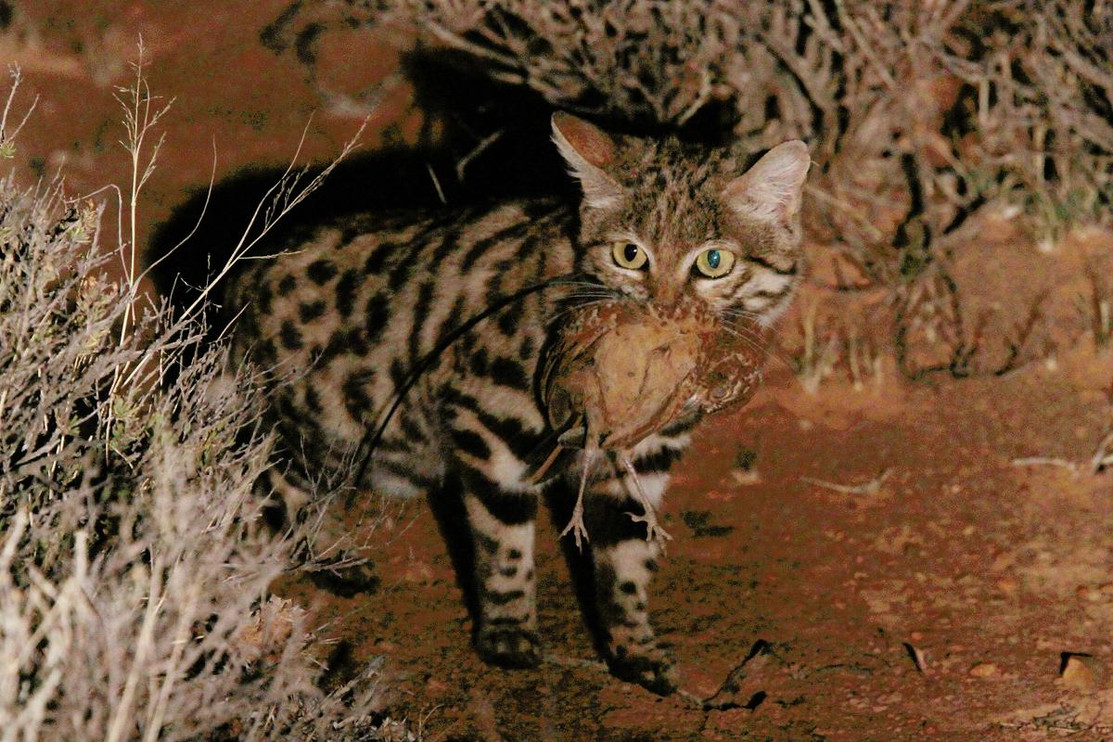
The black-footed cat has the highest hunting success rate of any wild cat, catching prey in roughly 60% of its attempts. (In contrast, lions succeed in only about 20 to 25% of their hunts.) So relentless is its appetite that it catches prey on average once every 50 minutes, eating up to one fifth of its body mass in a single night. It can take down prey larger than itself, such as the Cape hare, and snatch birds in flight and leap up to 1.4 meters high.

A black-footed cat holds a bird in its mouth.
The black-footed cat has the highest kill rate of any wild cat. © Alexander Sliwa

How does a cat this small rack up such numbers? Stealth and stamina. Its low stature lets it creep through short grass and Karoo vegetation almost undetected, giving it an edge over larger neighbors such as African wildcats, Cape foxes and caracals. This nocturnal, solitary hunter preys on some 40 vertebrate species — chiefly rodents and shrews, along with small birds, reptiles and large insects.

Status and Threats

The black-footed cat is listed as Vulnerable on the IUCN Red List of Threatened Species. With an estimated population of fewer than 10,000 mature individuals and numbers suspected to be declining, it is possibly the rarest cat in Africa.

What makes its future uncertain is not one threat but several that feed on one another. Most of its range lies outside protected areas, so the species depends on the goodwill of private and communal landowners. There, black-footed cats are lost to blanket predator control meant for other animals — poisoned baits, night shooting, trapping and hunting with dogs — and to larger predators such as caracals and black-backed jackals, whose numbers are climbing as landscapes change.

Habitat degradation from overgrazing and bush encroachment thins out their prey and erodes the burrows they rely on for shelter, since black-footed cats cannot dig their own and instead depend on dens made by springhares, aardvarks and other species. Climate change is also expected to intensify droughts, floods and the pressures that drive people and carnivores into conflict.

Because the species is so seldom seen, even measuring how these threats add up over time remains a challenge — which is exactly why long-term monitoring by groups like the Black-Footed Cat Working Group is important.

A black-footed cat peers out from inside its den.
By day, the black-footed cat shelters out of the heat, emerging after dark to hunt. © Alexander Sliwa

How Panthera Is Protecting the Black-Footed Cat

Small cats make up 33 of the world's 40 wild cat species, yet they receive a tiny fraction of global wild cat conservation funding — by some estimates, less than 1%. Panthera launched its Small Cats Program in 2018 to change that, building science-based conservation strategies for the world's most overlooked felines. The black-footed cat is one of the program's focal African species, alongside the sand cat and African golden cat.

For many small cats, the most urgent need is basic knowledge: Where do they live? How many are left? What threats do they face? Through the Small Cats Program and the Small Cat Action Fund — a grants program supporting in situ research and conservation on small cat species around the world — Panthera works with partners including the Black-Footed Cat Working Group to fill those knowledge gaps and secure a future for this species.

Want to meet more of the world's most underrated felines? Explore our Small Cat Spotlight Collection and learn how you can help by visiting Panthera's Small Cats Program.